
The calculus of modern construction has irrevocably shifted. It's no longer just about getting concrete from point A to point B; it's about mastering flow, volume, and time in a single, continuous operation. Enter the 90 cubic meter per hour concrete line pump—a machine that operates not as a mere tool, but as the central circulatory system for projects of a certain ambition. This isn't equipment for incremental progress; it's the engine for monumental output. We're moving past the realm of traditional pouring into the domain of strategic concrete placement, where hourly capacity becomes the critical path determinant. Let's dissect the project profiles where this specific volumetric throughput transitions from a luxury to a non-negotiable imperative.
Redefining Scale and Speed in Modern Infrastructure
The 90m³/h benchmark represents a distinct leap in construction methodology. This isn't about modestly accelerating a schedule; it's about enabling build phases that would be logistically or physically impossible with lower-capacity systems. The pump becomes the pace-setter, dictating a rhythm of work that demands and enables parallel trade coordination on a grand scale.
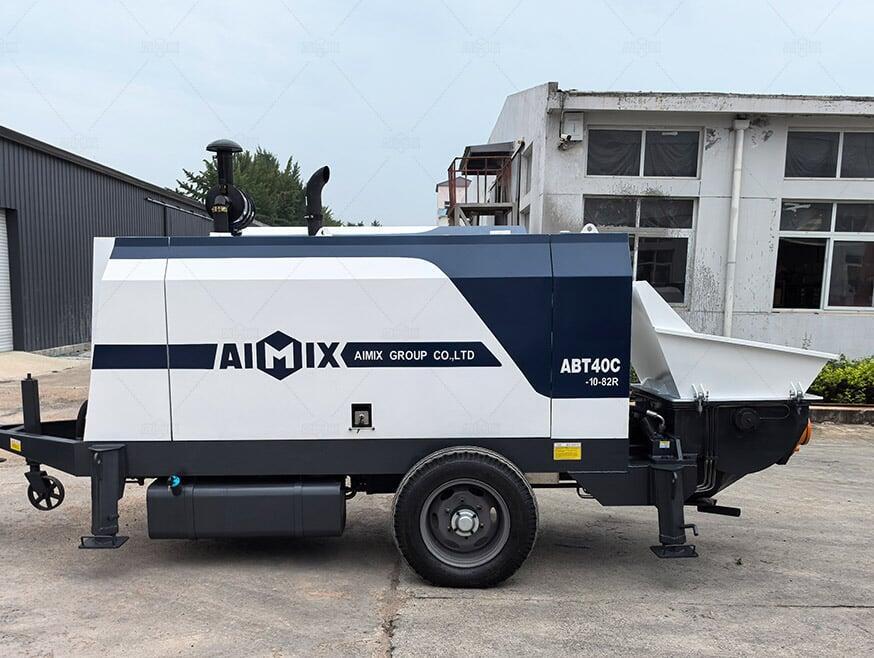
Consider the relentless tempo of today's high-density urban developments. We're talking about twin-tower residential complexes or commercial citadels with multiple basement levels and soaring cores. A 90m³/h line pump is the only viable solution for placing the massive mat foundations—often thousands of cubic meters—in a single, monolithic pour to prevent cold joints. For the superstructure, its high-pressure capability allows it to service floor slabs across a wide vertical and horizontal reach without constant, time-consuming relocation. The machine's output keeps pace with the flying form systems, ensuring that the critical cycle of form, reinforce, pour, and strip maintains its cadence. Slower pumping would create a bottleneck, stalling the entire production line of the skyscraper and eroding the financial model built on swift vertical progression.
This logic scales horizontally for major civil infrastructure. The continuous deck pour of a long-span bridge, the placement of vast airport apron slabs, or the lining of a major utility tunnel—these are exercises in volume continuity. A 90m³/h large mobile concrete pump provides the assured, uninterrupted flow needed to prevent surface imperfections and ensure structural homogeneity across these expansive planes. The alternative—multiple smaller pumps or discontinuous placement—introduces points of potential failure, inconsistencies in finish, and a tangled web of coordination overhead. The high-capacity pump consolidates the operation into a single, manageable, and predictable stream of material.
Technical Prowess: Precision Meets Uninterrupted Volume
The value proposition of a pump in this class isn't brute force alone. It's the sophisticated marriage of relentless output with precise control, enabling engineers to execute complex designs with both speed and fidelity.
Managing intricate pour sequences on a tight project timeline is a paramount challenge. A 90m³/h unit excels in this environment. Its ability to rapidly place large volumes is matched by a hydraulic system capable of nuanced control, essential for filling densely reinforced shear walls, columns, and diaphragm elements without segregation. This allows for the completion of entire vertical elements in one efficient operation, drastically reducing the number of construction joints and improving the final structure's seismic and load-bearing integrity. The pump’s power reserve also means it can handle sophisticated concrete mixes—self-consolidating, high-strength, or fiber-reinforced—over long pipeline distances without risk of line blockage, a constant threat with underpowered equipment.
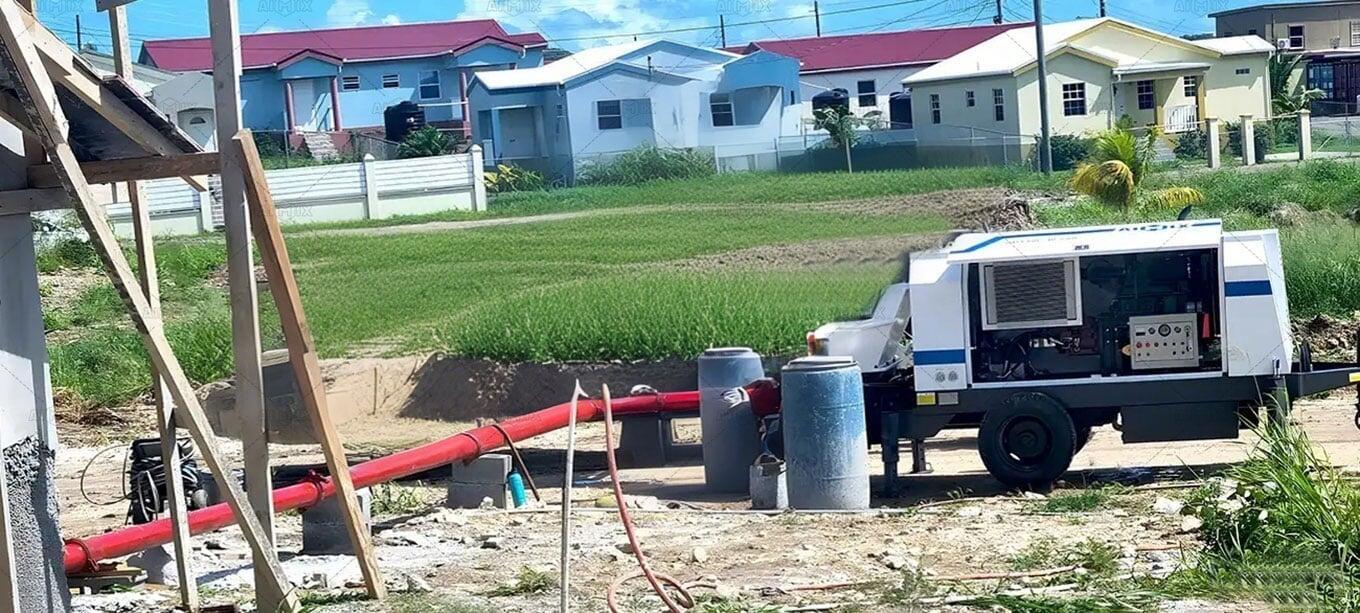
From a project economics standpoint, the justification is clear. The labor footprint for concrete placement is dramatically condensed. What might require multiple smaller pumps, a small army of vibrator operators, and complex logistics is streamlined into a centralized operation. This reduces direct labor costs, minimizes on-site congestion, and, most importantly, compresses the critical path timeline. The reduction in total placement time for major elements has a cascading positive effect, freeing up follow-on trades sooner and de-risking the schedule against weather or other delays. The machine’s efficiency converts directly into financial predictability and improved asset utilization.
Specialized Applications: Beyond Conventional Construction
The utility of this high-volume pumping capacity extends into more niche but equally demanding sectors where time and volume are existential project factors.
In geotechnical and heavy civil engineering, the construction of massive piled raft foundations or soil stabilization via slurry walls requires the continuous injection of enormous concrete quantities. A 90m³/h concrete pump portable is essential to maintain the necessary head pressure and flow to prevent collapse of borehole walls or to ensure complete encapsulation of reinforcement cages in deep foundations. Stopping is not an option. Similarly, in the world of industrial-scale precast production, where profit margins are tied to mold turnover rates, a stationary high-capacity pump dedicated to the batching plant becomes a productivity multiplier. It can fill large, complex mold forms for double-tee girders, tunnel segments, or architectural cladding panels in minutes, ensuring perfect compaction and a consistent finish cycle after cycle. This turns the casting yard into a true factory line, where the pump is the reliable, high-speed dispenser feeding the production rhythm.
Ultimately, specifying a 90m³/h concrete pump is a declaration of intent. It signals a project philosophy that prioritizes operational continuity, structural perfection, and temporal efficiency over mere convenience. It is the tool for those who build not just structures, but legacies defined by their scale, quality, and timely delivery.