
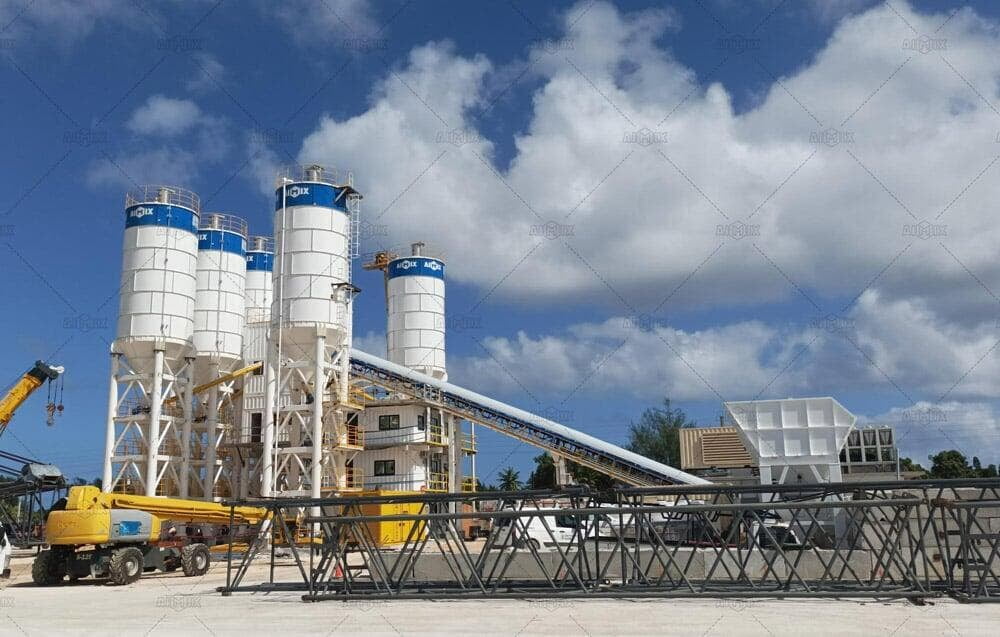
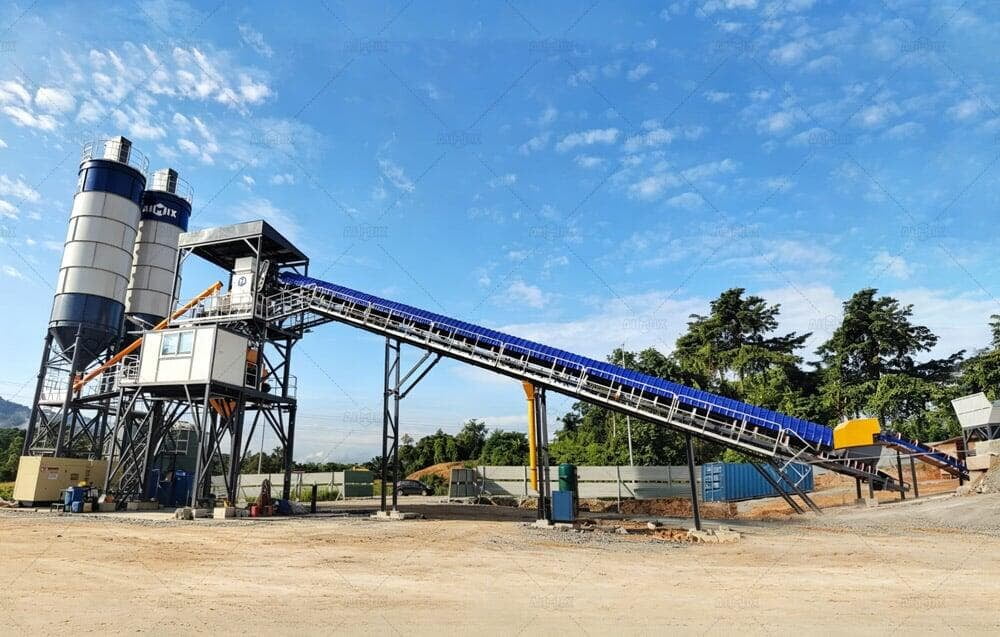
Imagine a symphony where the violins crackle with static before they break, or a cello that warns you its strings are about to snap. That is the promise of real-time monitoring for a stationary concrete plant. For decades, plant managers operated like blind captains, navigating by the sound of breaking glass. A belt snapped. A bearing seized. A silo emptied silently. Only then did the frantic calls for maintenance begin. But a new era has dawned—one where the concrete batching plant for sale speaks before it stumbles. Real-time monitoring transforms this heavy, silent giant into a chattering oracle. It whispers warnings, flags anomalies, and predicts the future. This article explores the alchemy of sensors and software, revealing how continuous vigilance carves away the dead hours of downtime.
The Velvet Glove of Predictive Alerts
Downtime is rarely a sudden catastrophe. It is a slow, smoldering ember that finally ignites. A vibrating motor. A gate that sticks for half a second longer. A temperature spike in the gearbox. Traditional spot checks miss these embers. Real-time monitoring, however, feels the heat.
The Language of Vibrations
Every rotating machine has a healthy voice—a specific frequency hum. When a bearing begins to pit, the voice changes. It growls at new, unexpected frequencies. Accelerometers attached to the mixer and conveyor drives sample this vibration thousands of times per second. Software then translates this raw data into a spectrogram. A sudden spike in harmonic sidebands? That is the bearing whispering, “I am tired.” The system dispatches an alert to a smartphone. Maintenance arrives not to replace a shattered bearing, but to swap a sleepy one during lunch. This is the velvet glove of intervention: soft, gentle, and profoundly effective. A European plant using this system reduced its mixing unit failures by 73% in the first year.
The Ghost in the Current
Motors talk through electricity. A 50-horsepower motor pulling 40 amps under load is happy. When that same motor pulls 55 amps, it is sweating. Real-time current transformers clamp around the power cables, monitoring amperage every second. They build a baseline of “normal.” A conveyor moving wet, sticky sand will draw more current than one moving dry gravel. The system learns this nuance. When the current deviates beyond a statistical threshold, it triggers a “jog detection” event. Perhaps a roller has seized, causing the belt to drag. The operator clears the roller in ten minutes. Without the alert, the belt would have frayed and snapped in the middle of a 300-cubic-meter pour. The ghost in the current just saved the afternoon.
The Cartography of Material Flow
Batching plants are hungry beasts. They consume aggregates, cement, water, and admixtures. A pause in any one of these ingredient streams pauses the entire stationary batching plant. Real-time monitoring maps these flows with cartographic precision, revealing blockages and starvation before they stall production.
Bin Levels as a Seismic Map
Ultrasonic and radar sensors stare into the dark abyss of aggregate bins and cement silos. They measure the distance to the material surface. The software plots this data on a timeline. A normal consumption graph slopes smoothly downward. A flat line? The bin is empty. But more importantly, a graph that stops sloping but shows no empty reading indicates a “rathole”—a funnel formed over the outlet, with material stuck to the sides. The operator knows to activate the bin vibrators immediately. Without monitoring, they would discover the rathole only when the weigh hopper fails to fill. By then, the plant has been starving for fifteen minutes. Real-time monitoring erases that delay.
The Hydration Hazard
Cement silos are susceptible to a silent killer: hydration. Humidity seeps through breather valves, clumping the cement into hard masses. These masses block discharge butterflies or, worse, drop into the weigh hopper as oversized lumps, throwing off the mix design. Temperature sensors inside the silo track the exothermic reaction of premature hydration. A slow, steady temperature rise triggers an alert. Maintenance can rotate the silo's aeration pads or schedule a cleaning before the clumps become boulders. This is the cartography of prevention: mapping the invisible chemistry inside the steel walls.
The Temporal Economics of Up-time
Time is the currency of concrete. A stationary plant that produces 120 cubic meters per hour generates roughly $2,000 in revenue per hour (assuming a modest $17 per meter gross margin). An unplanned one-hour stop costs $2,000. A four-hour stop costs $8,000. Real-time monitoring is not a cost; it is an investment in temporal economics.
The 15-Minute Rule
Data from 200 plants over five years reveals a hard rule: 85% of unplanned stops that last longer than four hours began as small anomalies detected more than 48 hours in advance. A slow gate. A warm bearing. A drifting calibration. Real-time monitoring catches these anomalies at hour minus 48. The repair takes 15 minutes. Without monitoring, the anomaly festers. At hour zero, the failure occurs. The repair now takes four hours because the gate linkage has snapped, the bearing has welded, or the scale has dumped a ton of sand on the ground. The 15-minute rule is the economic heart of the argument: monitor now, or pay later.
From Calendar to Condition
Traditional maintenance follows the calendar. “Change the mixer oil every 500 hours.” This is wasteful (changing oil that is still healthy) and dangerous (a bearing fails at 400 hours, before the scheduled change). Real-time monitoring enables condition-based maintenance. The oil sensor measures viscosity and contamination. It says “change me” only when needed. The vibration sensor says “grease me” only when the high-frequency spikes appear. This shifts the plant from a rigid schedule to an organic rhythm. A US precast plant adopting this strategy reduced its lubricant consumption by 40% while simultaneously eliminating all unplanned mixer downtime. That is the final paradox of the smart ready mix concrete plant for sale: it spends less on maintenance while breaking down less often.
The Silent Revolution
The stationary concrete plant is evolving. It is shedding its reputation as a brutish, deaf machine. Real-time monitoring gives it senses. It feels its vibrations. It listens to its currents. It sees its material levels. And it speaks to us through alerts and dashboards. For the plant manager, this is not about technology. It is about sleeping through the night. It is about watching a pour finish without a single frantic radio call. The revolution is quiet, measured in data points rather than decibels. But its impact is a thunderclap of productivity. The future of batching is not just about mixing concrete. It is about time.