
The purchase price of a portable concrete mixer pump represents only the most visible layer of its true financial impact. Beneath that headline figure lies a more consequential cost architecture shaped almost entirely by feed system design — the mechanical and hydraulic pathway through which concrete travels from the loading hopper, through the mixing chamber, and ultimately into the delivery hose. This pathway, deceptively straightforward in appearance, determines pumping efficiency, wear component longevity, blockage frequency, maintenance labour intensity, and energy consumption across the machine's operational lifespan. Understanding how feed design decisions propagate through total cost of ownership is essential for any contractor or procurement professional evaluating portable concrete pumps with genuine financial rigour rather than surface-level price comparison.
Hopper Geometry and Its Downstream Cost Implications
Feed Angle, Capacity, and Material Flow Efficiency
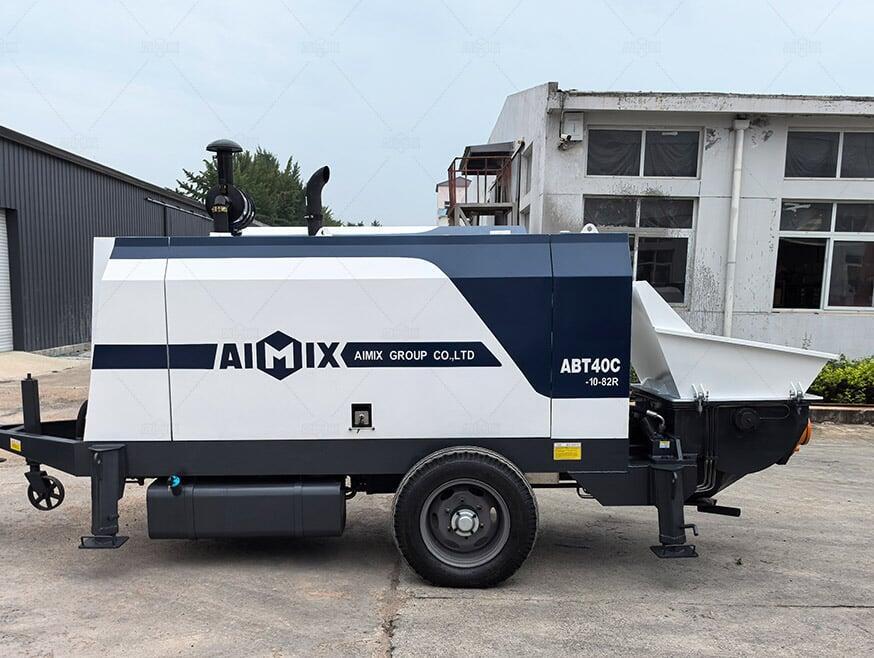
The hopper constitutes the entry point of the entire feed system, and its geometric configuration establishes the foundational conditions for everything that follows. Hopper feed angle — the inclination at which concrete transitions from the loading vessel into the mixing and pumping assembly — directly governs material flow continuity. Hoppers engineered with shallow feed angles create zones of stagnant concrete accumulation along internal walls, generating partial segregation of aggregate from paste, increased mixing motor loading, and elevated risk of premature blockage formation within downstream piping. Optimally designed hoppers incorporate steep-walled geometries, smooth internal surface finishes, and anti-segregation baffles that maintain homogeneous concrete movement from the moment of loading. The operational consequence of suboptimal hopper design manifests as increased pump cycling irregularity, elevated hydraulic system pressure demands, and accelerated wear across the S-valve or spectacle plate assembly — components whose replacement constitutes one of the most significant recurring maintenance expenditures in portable concrete mixer pump ownership.
Hopper Volume, Batch Continuity, and Labour Cost Interaction
Hopper volumetric capacity carries a less obvious but financially material influence on total operating cost through its interaction with labour deployment requirements. Undersized hoppers necessitate more frequent loading cycles to maintain continuous pumping output, increasing operator handling time, extending pour durations, and elevating the labour cost per cubic metre of concrete placed. On projects where crew time is billed at commercial rates — as is standard across commercial construction in the United States, Australia, and Western Europe — the cumulative labour premium attributable to inefficient feed continuity can substantially exceed the price differential between a budget and premium-specification hopper design. Conversely, generously dimensioned hoppers with optimised loading geometry reduce feed interruption frequency, sustain higher effective pumping output rates, and compress the labour hours required per unit volume of concrete placed — an efficiency gain that compounds meaningfully across high-volume or multi-day pumping operations.
Mixing Chamber Design and Wear Economics
Blade Configuration, Liner Metallurgy, and Replacement Frequency
Between the hopper and the pumping mechanism lies the mixing chamber — a component whose internal architecture profoundly influences both concrete quality and long-term maintenance expenditure. Mixing blade configuration determines the thoroughness of aggregate dispersion, water-cement ratio homogeneity, and the mechanical energy required to achieve specification-compliant consistency. Poorly configured blade geometries, or blades manufactured from insufficiently hard steel alloys, experience accelerated abrasive wear when processing concrete containing hard aggregate fractions — basalt, granite, or recycled concrete — generating progressive output quality deterioration before visible wear indicators become apparent to operators. Premium portable concrete mixer pump for sale specify mixing blades fabricated from high-chromium white iron or bimetallic composite materials exhibiting Brinell hardness values in excess of 550 HB, substantially extending service intervals compared to standard carbon steel alternatives. The financial calculus is direct: longer blade service life reduces replacement part expenditure, minimises production downtime during maintenance intervals, and lowers the total labour cost of scheduled servicing across the machine's operational lifespan.
Concrete Transition Zones and Blockage Prevention Engineering
The geometric transition between the mixing chamber outlet and the pumping cylinder inlet represents one of the most hydraulically demanding zones within the entire feed pathway. Abrupt cross-sectional changes, sharp directional transitions, or misaligned component interfaces at this junction create localised flow resistance that elevates pumping pressure requirements, accelerates wear at contact surfaces, and significantly increases blockage susceptibility when processing stiff-consistency or aggregate-rich mix designs. Manufacturers who engineer smooth, radius-transitioned feed pathways with precision-machined mating surfaces at chamber-to-cylinder interfaces deliver measurably lower operating pressures, reduced hydraulic system thermal loading, and substantially diminished blockage incidence — a benefit whose financial value is best appreciated by any operator who has experienced the productivity loss, material waste, and pipeline clearing labour associated with a concrete blockage event mid-pour.
Delivery Hose System Design and Long-Term Operational Cost
Hose Diameter, Material Specification, and Pressure Loss Economics
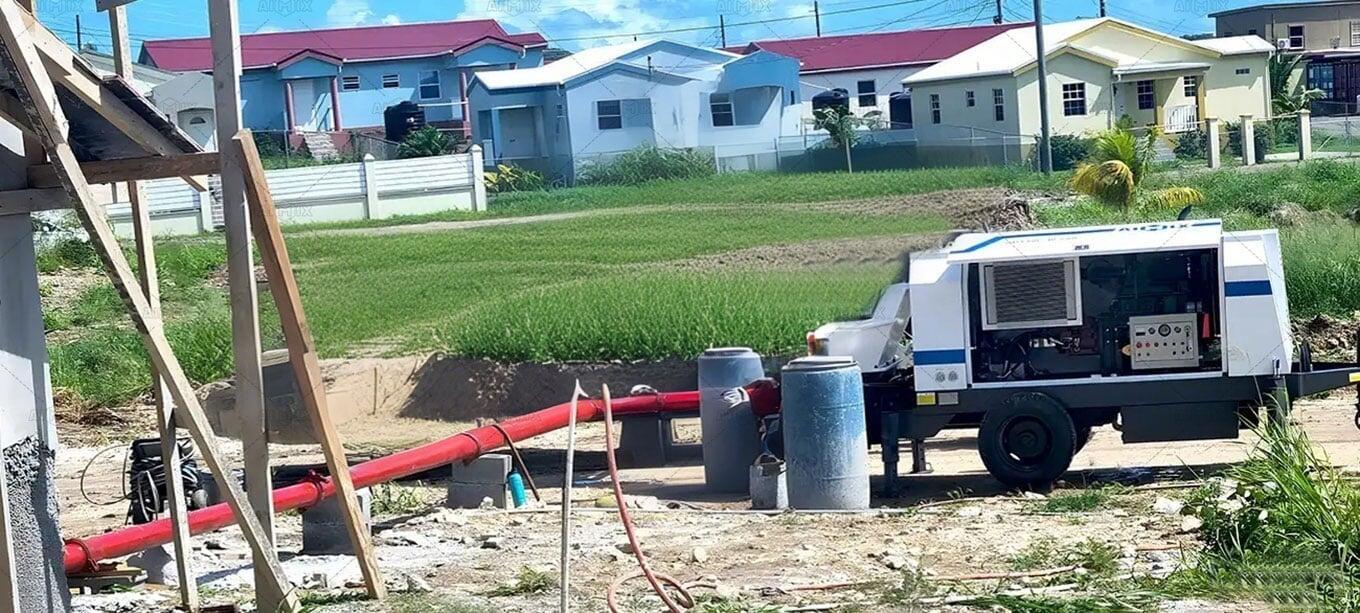
The delivery hose system — extending from the pump outlet to the concrete placement point — represents the terminal stage of the feed pathway and a domain of considerable cost variability depending on specification quality. Hose internal diameter selection involves a direct trade-off between pumping pressure requirements and aggregate passage capability. Undersized hose diameters elevate pipeline resistance, demanding higher hydraulic pump operating pressures that accelerate seal wear, increase fuel consumption, and reduce the effective pumping distance achievable before pressure limitations constrain placement reach. Premium hose assemblies specify abrasion-resistant natural rubber or composite polymer liners engineered to withstand the continuous mechanical abrasion generated by aggregate-laden concrete flow, delivering service lives two to three times those of economy-grade alternatives. When evaluated across cumulative replacement cycles over a machine's operational life, the premium paid for superior hose specification consistently delivers net cost reduction — a conclusion that applies with particular force in high-utilisation applications where hose replacement frequency under economy-grade specifications becomes a material operational burden.
Coupling Integrity, Leak Prevention, and Total System Reliability
Hose coupling design and manufacturing quality represent the final determinant of feed system cost performance, and one frequently underweighted in procurement evaluations focused predominantly on concrete mixer with pump unit pricing. Coupling failures — manifesting as concrete leakage at hose joints, progressive seal deterioration, or acute coupling separation under pressure — generate consequences disproportionate to the modest cost of the component itself. Concrete leakage at coupling points contaminates the work environment, creates safety hazards, wastes material, and necessitates immediate operational interruption for remediation. Precision-machined coupling assemblies with positive-locking cam mechanisms, elastomeric seals specified for concrete abrasion resistance, and corrosion-resistant surface treatments deliver coupling integrity that economy alternatives cannot reliably sustain across extended operational cycles. The aggregate financial impact of coupling quality — expressed through reduced material waste, minimised unplanned downtime, and lower maintenance labour intensity — reinforces the fundamental principle that total portable concrete mixer pump cost is determined not by any single component, but by the cumulative performance of every element within the feed pathway from hopper to hose.